Usage of AspectJ style AOP
Please refer to spring-framework under org.springframework.mylearntest package for code related to this article (from official source spring-test module).
No need to implement corresponding interfaces like in 1.0, the only thing to do is to add an @Aspect annotation on this Aspect class. This way we can determine which classes in ClassPath are Aspect definitions we are looking for. Define Pointcut via @Pointcut, specify which methods define corresponding Advice logic via annotations like Around.
PerformanceTraceAspect
package org.springframework.mylearntest.aop2.aspectj;

import org.apache.commons.lang3.time.StopWatch;
import org.apache.commons.logging.Log;
import org.apache.commons.logging.LogFactory;
import org.aspectj.lang.ProceedingJoinPoint;
import org.aspectj.lang.annotation.Around;
import org.aspectj.lang.annotation.Aspect;
import org.aspectj.lang.annotation.Pointcut;

/**
 * @Author: whalefall
 * @Date: 2020/7/28 22:46
 * After Spring 2.0 no need to implement interfaces to define pointcut
 */
@Aspect
public class PerformanceTraceAspect {
	private final Log logger = LogFactory.getLog(PerformanceTraceAspect.class);

	@Pointcut("execution(public  void *.method1()) || execution(public  void *.method2())")
	public void pointcutName() {}

	@Around("pointcutName()")
	public Object performanceTrace(ProceedingJoinPoint joinPoint) throws Throwable {
		StopWatch sw = new StopWatch();
		try {
			sw.start();
			return joinPoint.proceed();
		} finally {
				System.out.println("pt in method["
						+ joinPoint.getSignature().getName()
				+ "]>>>>>>" + sw.toString());
		}
	}
}
Two Ways to Weave Aspect
Suppose we have a target object Foo, there are two ways to weave Aspect definition into this target object class, to achieve interception of Joinpoints conforming to Pointcut definition.
Foo
public class Foo {
	public void method1() {
		System.out.println("method1 executed");
	}

	public void method2() {
		System.out.println("method2 executed");
	}
}
Programmatic Weaving
Implemented via AspectJProxyFactory
public class Test4AspectJProxyFactory {
	public static void main(String[] args) {
		AspectJProxyFactory weaver = new AspectJProxyFactory();
		weaver.setProxyTargetClass(true);
		weaver.setTarget(new Foo());
		weaver.addAspect(PerformanceTraceAspect.class);
		Object proxy = weaver.getProxy();
		((Foo)proxy).method1();
		((Foo)proxy).method2();
	}
}
Weaving via Auto-Proxy
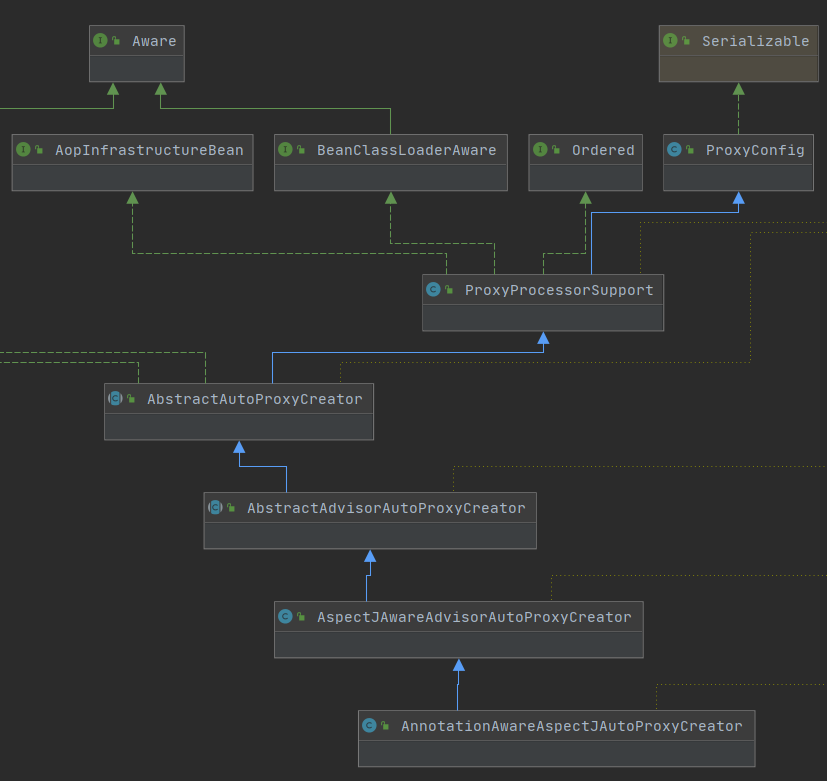
For @AspectJ style AOP, Spring AOP specifically provides an AutoProxyCreator implementation class for automatic proxying, to avoid excessive coding and configuration work. It is an extension class based on AbstractAdvisorAutoProxyCreator.
Like AutoProxyCreator, we just need to register AnnotationAwareAspectJAutoProxyCreator in IoC container configuration file.
xml configuration
<beans xmlns="http://www.springframework.org/schema/beans"
	   xmlns:xsi="http://www.w3.org/2001/XMLSchema-instance"
	   xmlns:aop="http://www.springframework.org/schema/aop"
	   xsi:schemaLocation="http://www.springframework.org/schema/beans
		http://www.springframework.org/schema/beans/spring-beans-2.5.xsd

		 http://www.springframework.org/schema/aop https://www.springframework.org/schema/aop/spring-aop.xsd">

	<aop:aspectj-autoproxy proxy-target-class="true"/>
	<!--	Equivalent to line above-->
	<!--<bean class="org.springframework.aop.aspectj.annotation.AnnotationAwareAspectJAutoProxyCreator">
		<property name="proxyTargetClass" value="true"/>
	</bean>-->

	<bean id="performanceAspect" class="org.springframework.mylearntest.aop2.aspectj.PerformanceTraceAspect"/>

	<bean id="target" class="org.springframework.mylearntest.aop2.aspectj.Foo"/>
</beans>
TestAutoAspectJ
public class Test4AutoAspectJ {
	public static void main(String[] args) {
		ApplicationContext context = new ClassPathXmlApplicationContext("annotationawareaspectJautoproxycreator\\annotationawareaspectJautoproxycreator.xml");
		Object proxy = context.getBean("target");
		((Foo)proxy).method1();
		((Foo)proxy).method2();
	}
}
If target is injected as dependency object into other bean definitions, then what dependency subject object holds is also proxied target object.
Tip
When using @AspectJ style AOP, should try to use automatic proxy support in container. Usually, programmatic weaving operations are only used for testing puproses. In process of use, you will find that actually there are differences between these two ways, some behaviors are not unified.
Using @Aspect style AOP needs to introduce
aspectjweaver.jarandaspectjrt.jar.
@AspectJ style Pointcut
Before Spring framework released version 2.0, Spring AOP did not have formal Pointcut description language like AspectJ, and only supported method-level interception. So usually, simple method name specification and regular expressions basically could achieve purpose well.
After Spring released version 2.0, Spring AOP framework integrated parts of AspectJ functions, including AspectJ's Pointcut language support. Transitioned from DTD to XSD era.
@AspectJ style Pointcut Declaration Way
@AspectJ style Pointcut declaration is attached to @AspectJ, by using org.aspectj.lang.annotation.Pointcut annotation, after specifying AspectJ style Pointcut expression, mark this annotation specified with corresponding expression on a method of Aspect definition class.
@AspectJ style Pointcut declaration contains following two parts.
- Pointcut Expression
Carrier of Pointcut Expression is @Pointcut, this annotation is method-level annotation, so Pointcut Expression cannot be declared separately from a method
Expression consists of two parts, namely Pointcut Signature and Expression Matching Pattern.
- Pointcut Signature
It is a definition of a method, acting as carrier of Pointcut Expression. Method definition where Pointcut Signature is located has no other restrictions except that return type must be void. Method modifiers play same semantic role as in java language, public Pointcut Signature can be referenced in other Aspect definitions, while private can only be referenced in current Aspect definition. Can use Pointcut Signature as identifier of corresponding Pointcut Expression, replacing repetitive Pointcut expression definitions in Pointcut Expression definition.
YourAspect
@Aspect
public class YourAspect {
    @Pointcut("execution(void method1())")
    public void method1Execution() {}

    @Pointcut("method1Execution()")
    private void stillMethod1Execution() {}

    // ...
}
Identifiers of AspectJ style Pointcut Expression
execution
Using it will help us match Joinpoints having specified method signature, usage format as follows
execution(modifiers-pattern ? ret-type-pattern declaring-type-pattern ? name-pattern(param-pattern) throws-pattern?)
Where method return type, method name, and parameter part matching patterns must be specified, matching patterns of other parts can be omitted.
Foo Example
public class Foo {
    public void doSomething(String arg) {
        // ...
}
}
Then can specify following Pointcut expression to match doSomething method of Foo
execution(public void Foo.doSomething(String))

execution(void Foo.doSomething(String))
* can be used in matching pattern of any part, can match multiple adjacent characters *
execution(* *(String))

execution(* *(*))
.. wildcard can be used in two positions
- Use specified multi-level type declaration at
declaring-type-pattern
// Can only locate all types under layer cn.spring21
execution(void cn.spring21.*.doSomething(*)

// Can match all under cn.spring21 package including descendant packages
execution(void cn.spring21..*.doSomething(*)
- Used in method list matching position, indicates that method can have 0 to multiple parameters, parameter types unlimited. If
..is replaced by*, then can only match one parameter.
execution(void *.doSomething(..))

// Indicates first parameter is String, second parameter is any type
execution(void doSomething(String,*))

// Indicates unlimited parameter format, unlimited type, but last parameter type must be String
execution(void doSomething(..,String))
within
within identifier only accepts type declarations, it will match all Joinpoint methods under specified type.
within pointcut expression usage
within(cn.spring21.aop.target.MockTarget)
// Match method-level Joinpoints inside all classes under target package
within(cn.spring21.aop.target.*)
// Match method-level Joinpoints inside all classes under aop package and descendant packages
within(cn.spring21.aop..*)
within pointcut expression usage
@Retention(RetentionPolicy.RUNTIME)
@Target({ElementType.METHOD,ElementType.TYPE})
public @interface AnyJoinpointAnnotation {}
@AnyJoinpointAnnotation
public class Foo{
    public void method1(){}
    public void method2(){}
}
When using Pointcut expression @within(AnyJoinpointAnnotation), methods like method1, method2 in Foo class will all be matched by Pointcut expression. Because this class is marked with @AnyJoinpointAnnotation, if other classes are also marked with this annotation, will also be matched.
Note @within only accepts annotation types, and takes effect on classes marked by specified annotation type
this and target
In AspectJ, this refers to object where calling method is located, target refers to object where called method is located, so usually these two identifiers can be used simultaneously to limit calling relationship of methods. For example, if Object1, Object2 both call a method of Object3, then Pointcut expression definition this(Object2) && target(Object3) will only match when Object2 calls method on Object3, while Object1 calling method on Object3 will not be matched.
Semantics of this and target in Spring AOP differ from AspectJ, this refers to proxy object of target object, while target is target object.
Regardless of using interface-based proxy mode or class-based proxy mode, this(ProxyInterface) and target(ProxyInterface) have similar effects.
If specifying concrete type this(TargetFoo) and target(TargetFoo), target(TargetFoo) matches all Joinpoints in target object, because target object is indeed TargetFoo type, while this(TargetFoo) cannot.
this and target identifiers are both used in combination with other identifiers in Pointcut expressions to further strengthen matching qualification rules.
execution(void cn.spring21.*.doSomething(*)) && this(TargetFoo)

execution(void cn.spring21.*.doSomething(*)) && targe(ProxyInterface)

// Match implementing both ProxyInterface and ProxyInterface2
this(ProxyInterface) && target(proxyInterface2)
In Spring AOP @within and @target do not have much difference. It's just that @within belongs to static matching, while @target matches Joinpoint dynamically at runtime.
args
Function of this identifier is to help us capture method-level Joinpoints with specified parameter types and specified parameter amount, regardless of what type method is declared in. For example, args(cn.spring21.unveilspring.domain.User) then following method signatures will be matched
public class Foo {
    public boolean login(User user) {
        // ...
    }
}

public class Bar {
    public boolean isLogin(User user) {
        // ...
    }
}
To capture public boolean login(Object user), using expression like execution(* *(User)) cannot capture (because it is static Pointcut), need to use args identifier.
Pointcut expression using @args identifier will check method parameter types of current method-level Joinpoint, if passed parameter type this time has annotation specified by @args, current Joinpoint will be matched.
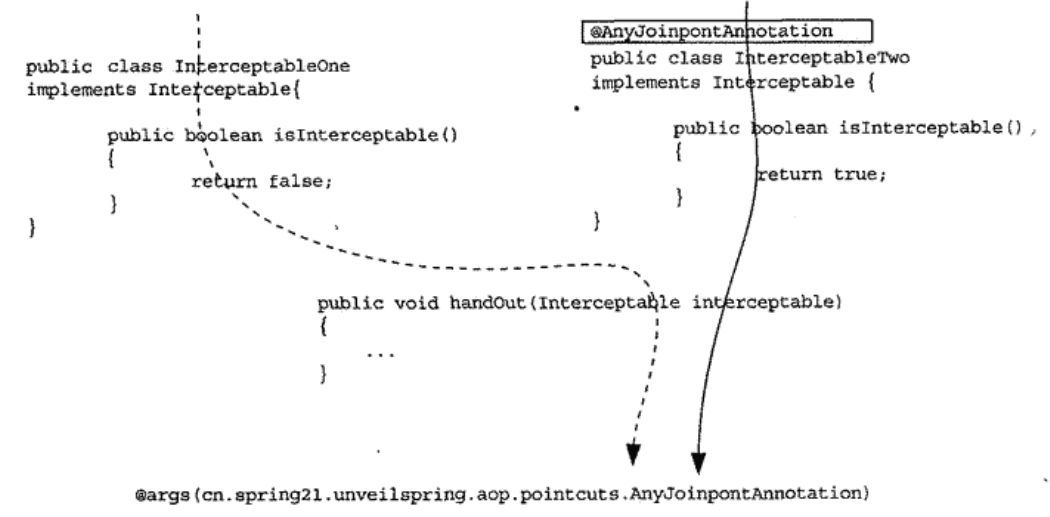
@args will attempt to dynamically check specified annotation for parameters of every method execution of all objects in system. As long as parameter type is marked with annotation type specified by @args, current method execution will match.
annotation
Pointcut expression using annotation identifier will attempt to check all method-level Joinpoints of all objects in system. If checked method is marked with annotation type specified by @annotation identifier, then Joinpoint where current method is located will be matched by Pointcut expression.
Want following method to support transaction mechanism, just need to add an annotation @Transactional on corresponding method, then use Pointcut expression to specify @annotation(org.springframework.transaction.annotation.Transactional). Note @Transactional annotation is defined as @Target(ElementType.METHOD).
Even though Pointcut expression identifiers in AspectJ can be used in Spring AOP, their semantics and final semantics in AspectJ will differ. So, rather than saying Spring AOP can now use AspectJ's Pointcut expression language, it is better to say Spring AOP borrowed "outer cloak" of AspectJ's Pointcut expression language, while actually underlying semantics and final matching still follow original mechanism of Spring AOP. In addition, Spring AOP may add new identifiers based on original expressions, such as bean(..). AspectJ extended Java language, now Spring AOP's Pointcut expressions will extend AspectJ's Pointcut.
True face of @AspectJ style Pointcut in Spring AOP
Actually, all Pointcut expressions declared in @AspectJ style will be parsed and converted into concrete Pointcut objects inside Spring AOP. Because Spring AOP has its own Pointcut definition structure, so declaring these Pointcut expressions in @AspectJ style will ultimately be converted into a Pointcut implementation specifically oriented towards AspectJ.
org.springframework.aop.aspectj.AspectJExpressionPointcut represents concrete implementation of Pointcut oriented towards AspectJ in Spring AOP. Although it uses corresponding support of AspectJ, it still follows Pointcut definition of Spring AOP.
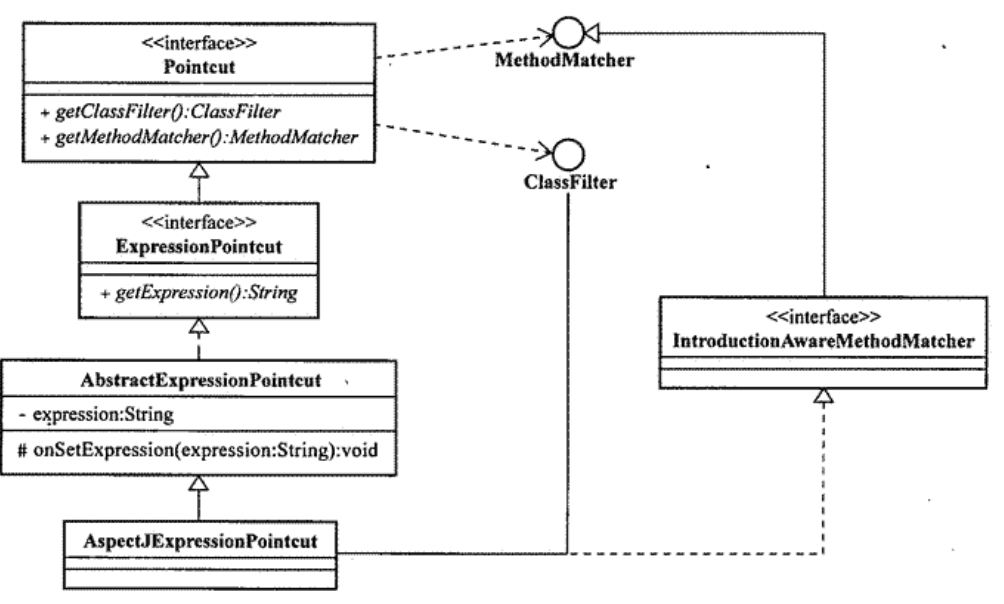
Defining ExpressionPointcut and AbstractExpressionPointcut is mainly for future extensibility. If there are forms other than AspectJ's Pointcut description language, we can integrate on basis of these two.
After AspectJProxyFactory or AnnotationAwareAspectJAutoProxyCreator obtains definition in @AspectJ style defined by @Pointcut in AspectJ via reflection, a corresponding AspectJExpressionPointcut object instance will be constructed inside Spring AOP framework. AspectJExpressionPointcut internally holds Pointcut expression obtained via reflection.
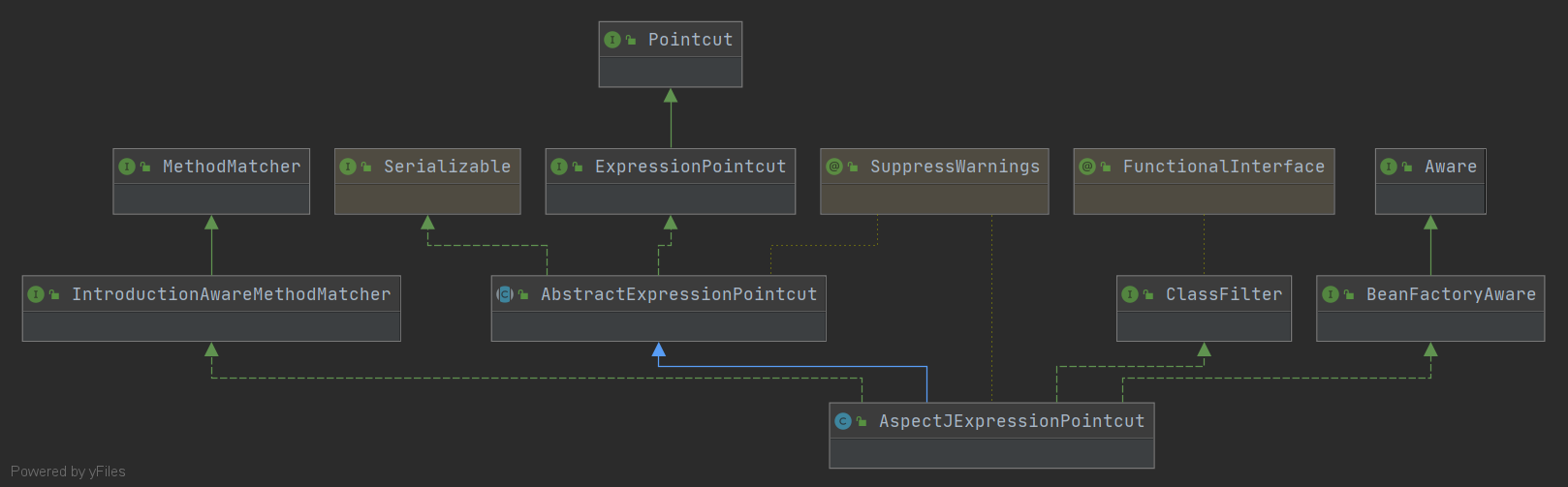
AspectJExpressionPointcut belongs to one of Spring AOP's Pointcut definitions, logic of Spring AOP framework internally processing Pointcut matching does not need to change, still uses original matching mechanism, i.e., performing matching work of concrete Joinpoint via ClassFilter and MethodMatcher. However, when implementing corresponding method logic of ClassFilter and MethodMatcher, AspectJExpressionPointcut will delegate specific work to relevant classes of AspectJ library. AspectJExpressionJoinpoint (should be Pointcut) will delegate PointcutParser in AspectJ library to parse @AspectJ style Pointcut expression held by it. After PointcutParser parsing is completed, it will return a PointcutExpression object (still a class in AspectJ library), afterwards whether matching or not is directly delegated to relevant methods of this PointcutExpression object for processing.
AspectJExpressionPointcut belongs to Pointcut implementation oriented towards AspectJ, we can use it like other various Pointcut implementation classes in Spring AOP. Only that, after construction, instead of setting method name or regular expression for it, set @AspectJ style Pointcut as shown below
AspectJExpressionPointcut pointcut = new AspectJExpressionPointcut();
pointcut.setExpression("execution( * someMethodName(..))");
@AspectJ style Advice
Definition in @AspectJ style is actually ordinary methods in Aspect definitions class marked with @AspectJ, only that these methods need to be marked with annotations corresponding to different Advice types.
Use Pointcut to set BeforeAdvice
/**
 * Use AspectJ style
 */
@Aspect
public class ResourceSetupAspectJ {
    private Resource resource;

    @Before("execution(boolean *.execute())")
    public void setupResourcesBefore() throws Throwable {
        if(!getResource().exists())
            FileUtils.forceMkdir(getResource().getFile());
    }
    // Omit getter setter
}
Use Pointcut Signature to reference Pointcut
Parameter passing in Advice
In some cases, we may need to access method parameters at Joinpoint in Advice definition. In 1.x Spring AOP, we can access corresponding method parameters via Object array passed in MethodBeforeAdvice method. Now there are two ways to achieve same purpose.
-
Via
org.aspectj.lang.JoinPoint. In @AspectJ style Aspect, method defining Before Advice can declare first parameter asorg.aspectj.lang.JoinPointtype. ThroughJoinpointwe can access argument values of corresponding Joinpoint method via itsgetArgs()method. In addition we can usegetThis()to get current proxy object,getTarget()to get target object. -
Binding via
argsidentifier. We have already introducedargsidentifier before, we can further limit Pointcut definition by specifying corresponding object type for it. Whenargsidentifier accepts not concrete object type but a parameter name, it will bind parameter value corresponding to this parameter name to call of Advice method.
Note parameter name specified by args must be same as parameter name of method where Advice definition is located. Here value specified by args and parameter name of setupResourceBefore method are both taskName. If Advice references independent Pointcut definition, using args binding form is also similar.
Advice references independent Pointcut definition
@Pointcut("execution(boolean *.execute(String,..)) && args(taskName)")
private void resourceSetupJoinpoints(String taskName) {}

@Before(value="resourceSetupJoinpoints(taskName)")
public void setupResourcesBefore(String taskName) throws Throwable{}
Function of simultaneously using JoinPoint and using args parameter name binding
@Before(value="execution(boolean *.execute(String,..)) && args(taskName)")
public void setupResourcesBefore1(JoinPoint joinpoint, String taskName) throws Throwable {
    // ...
}
Two ways for Before Advice to access method parameters
In Advice declaration way of AspectJ style, not only first parameter of Before Advice method can be declared as org.aspectj.lang.JoinPoint type, actually, except Around Advice and Introduction cannot use, method declarations of remaining Advice types all follow this rule
Not only args identifier can be used to bind parameter declaration to method, actually in Pointcut identifiers, except execution identifier which does not directly specify object type, others like this, target, @within, @target, @annotation, @args etc. originally all specify object types. Like args, in such occasions, if they specify parameter name
Configuration declaration way of various Advice in Spring 2.0 based on XSD
AspectAdvice
package org.springframework.mylearntest.aop2.schemaapsect;

import org.apache.commons.io.FileUtils;
import org.apache.commons.lang3.exception.ExceptionUtils;
import org.aspectj.lang.JoinPoint;
import org.aspectj.lang.ProceedingJoinPoint;
import org.aspectj.lang.annotation.*;
import org.springframework.core.io.Resource;
import org.springframework.util.StopWatch;

/**
 * @Author: WhaleFall541
 * @Date: 2020/8/13 20:56
 */
@Aspect
public class AspectAdvice {
    private Resource resource;

    public Resource getResource() {
        return resource;
    }

    public void setResource(Resource resource) {
        this.resource = resource;
    }

    @AfterThrowing(pointcut = "execution(boolean *.execute(String, ..))", throwing = "e")
    public void afterThrowing(RuntimeException e) {
        final String exceptionMsg = ExceptionUtils.getStackTrace(e);
        // ...
    }

    @AfterReturning(value = "execution(boolean *.execute(String, ..))",returning = "retValue")
    public void taskExceptionCompleted(JoinPoint jp,boolean retValue) {
        //Class clazz = jp.getTarget().getClass();
        //getSqlMapClientTemplate().insert("BATCH.insertTaskStatus", clazz.getName());
    }

    @After("execution(boolean *.execute(String, ..))")
    public void cleanUpResourcesIfNecessary() throws Throwable {
        if (getResource().exists())
            FileUtils.forceMkdir(getResource().getFile());
    }

    @Around("execution(boolean *.execute(String, ..))")
    public Object performanceTrace(ProceedingJoinPoint pjp) throws Throwable {
        StopWatch watch = new StopWatch();
        try {
            watch.start();
            return pjp.proceed();
        } finally {
            watch.stop();
            System.out.println("watch.toString() = " + watch.toString());
        }
    }
}
Introduction
In Spring, implementation of Introduction is by adding new behavioral logic to be added as new interface definition to target object. To declare Introduction in @AspectJ style, we need to declare an instance variable in Aspect, its type corresponds to type of newly added interface, then use org.aspectj.lang.annotatioin.DeclareParents to mark it. Specify implementation class of newly added interface definition via @DeclareParents and target object to which it will be added.
IntroductionAspect
package org.springframework.mylearntest.aop2.introduction;

import org.aspectj.lang.annotation.Aspect;
import org.aspectj.lang.annotation.DeclareParents;
import org.springframework.mylearntest.aop1.weaver.proxyfactorybean.CounterImpl;
import org.springframework.mylearntest.aop1.weaver.proxyfactorybean.ICounter;

/**
 * @Author: WhaleFall541
 * @Date: 2020/8/9 16:50
 * Introduce ICounter behavior to ITask
 */
@Aspect
public class IntroductionAspect {
	// value attribute specifies an object to be applied to, can also be all classes under a package value="cn.spring21.unveilspring.service.*"
	// Specify implementation class of newly added interface definition via defaultImpl, here implementation class of ICounter is org.springframework.mylearntest.aop1.weaver.proxyfactorybean.CounterImpl
	@DeclareParents(value = "org.springframework.mylearntest.aop1.weaver.baseoninterface.MockTask", defaultImpl =
			CounterImpl.class)
	public ICounter counter;// ICounter is object type to be added to target object
}
xml configuration
<?xml version="1.0" encoding="UTF-8"?>
<beans xmlns="http://www.springframework.org/schema/beans"
	   xmlns:xsi="http://www.w3.org/2001/XMLSchema-instance"
	   xmlns:context="http://www.springframework.org/schema/context"
	   xsi:schemaLocation=
			   "http://www.springframework.org/schema/beans http://www.springframework.org/schema/beans/spring-beans-2.0.xsd
				http://www.springframework.org/schema/context http://www.springframework.org/schema/context/spring-context-3.2.xsd
              	  http://www.springframework.org/schema/aop https://www.springframework.org/schema/aop/spring-aop.xsd"
	   xmlns:aop="http://www.springframework.org/schema/aop">

	<aop:aspectj-autoproxy proxy-target-class="true"/>

	<bean id="task" class="org.springframework.mylearntest.aop1.weaver.baseoninterface.MockTask" scope="prototype"/>

	<bean id="counterIntroduction" class="org.springframework.mylearntest.aop2.introduction.IntroductionAspect"/>
</beans>
Test4IntroductionAspect
package org.springframework.mylearntest.aop2.introduction;

import org.springframework.context.ApplicationContext;
import org.springframework.context.support.ClassPathXmlApplicationContext;
import org.springframework.mylearntest.aop1.weaver.proxyfactorybean.ICounter;

/**
 * @Author: WhaleFall541
 * @Date: 2020/8/9 17:10
 */
public class Test4IntroductionAspect {
	public static void main(String[] args) {
		ApplicationContext context = new ClassPathXmlApplicationContext("introductionaspect/introductionaspect.xml");
		Object task1 = context.getBean("task");
		Object task2 = context.getBean("task");

		System.out.println(((ICounter)task1).getCounter()); // 1
		System.out.println(((ICounter)task1).getCounter()); // 2
		System.out.println(((ICounter)task2).getCounter()); // 1
	}
}
Note Introduction belongs to per-instance type Advice, so do not forget that scope of target object should usually be set to prototype
Execution Order of Advice
If multiple Advices matching same Joinpoint are declared in same Aspect definition, then execution order of these Advices is determined by their declaration order in Aspect. Advice declared first has highest priority. For Before Advice, highest priority runs first, while for AfterReturningAdvice, highest priority runs last.
MultiAdviceAspect
package org.springframework.mylearntest.aop2.priorityofadvice;

import org.aspectj.lang.annotation.AfterReturning;
import org.aspectj.lang.annotation.Aspect;
import org.aspectj.lang.annotation.Before;
import org.aspectj.lang.annotation.Pointcut;

/**
 * @Author: WhaleFall541
 * @Date: 2020/8/9 18:00
 * If this AspectJ is woven into target object, result obtained can be
 * before one
 * before two
 * after returning two
 * after returning one
 */
@Aspect
public class MultiAdviceAspect {
	@Pointcut("execution(boolean *.execute(String, ..))")
	public void taskExecution(){}

	@Before("taskExecution()")
	public void beforeOne() {
		System.out.println("before one");
	}

	@Before("taskExecution()")
	public void beforeTwo() {
		System.out.println("before two");
	}

	@AfterReturning("taskExecution()")
	public void afterReturningOne() {
		System.out.println("after retuning one");
	}

	@AfterReturning("taskExecution()")
	public void afterReturningTwo() {
		System.out.println("after retuning two");
	}
}
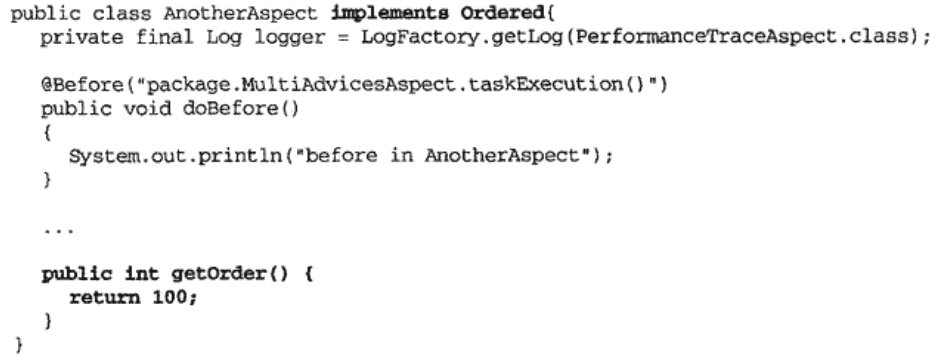
When these Advices are declared in different Aspects. If Pointcut definitions corresponding to multiple Advice declarations match same Joinpoint, but they are not declared in same Aspect. We need to use Spring's org.springframework.core.Ordered interface, just need corresponding Aspect definition to implement Ordered interface, otherwise execution order of Advice is undefined.
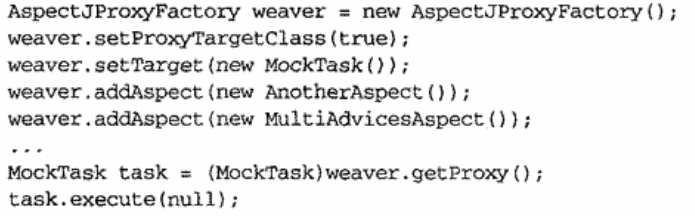
Note: If these Aspects are used via programmatic way, execution order of Advice inside Aspect is completely determined by order added to AspectJProxyFactory, not order prescribed by Ordered interface. If order of following code is adopted, then Advice in AnotherAspect will execute prior to Advice in MultiAdviceAspect.
Instantiation Mode of Aspect
For each Aspect registered to container, its default instantiation mode uses singleton, single instance of each Aspect definition will be instantiated and held in container (behavior coincides exactly with behavior of container singleton type scope).
Besides instantiation mode, AspectJ also supports instantiation modes like perthis, pertarget, percflow, percflowbelow and perwithin, but after Spring 2.0 AOP only supports default singleton, perthis and pertarget three instantiation modes.
To specify instantiation mode of corresponding Aspect, can specify perthis or pertarget statement via @Aspect. If want to chang instantiation mode of MultiAdviceAspect from default singleton to perthis. Can specify as follows
@Aspect("perthis(execution(boolean *.execute(String, ..)))")
public class MultiAdviceAspect {

    @Pointcut("execution(boolean *.execute(String, ..))")
    public void taskExecution(){}

    // ..

}
After Pointcut definition specified by perthis matches, respective Aspect instances will be instantiated for corresponding proxy objects. For pertarget, it instantiates corresponding Aspect for matching independent target object. However, after using perthis or pertarget to specify Aspect instantiation mode, when registering these Aspects to container, cannot specify singleton scope for their bean definitions, otherwise exception will occur.
References
- Book Name: Spring Unveiled Author: Wang Fuqiang
- Attribution: Retain the original author's signature and code source information in the original and derivative code.
- Preserve License: Retain the Apache 2.0 license file in the original and derivative code.
- Attribution: Give appropriate credit, provide a link to the license, and indicate if changes were made.
- NonCommercial: You may not use the material for commercial purposes. For commercial use, please contact the author.
- ShareAlike: If you remix, transform, or build upon the material, you must distribute your contributions under the same license as the original.