Weaving in Spring AOP 1
Please refer to spring-framework under org.springframework.mylearntest package for code related to this article (from official source spring-test module).
AspectJ uses ajc compiler as its weaver; JBoss AOP uses custom ClassLoader as its weaver; while in Spring AOP, class org.springframework.aop.framework.ProxyFactory is used as weaver.
Usage:
-
Pass in object to be woven
ProxyFactory weaver = new ProxyFactory(target); -
Bind Advisor that will be applied to target object to weaver
- If it is not an
IntroductionAdvice type, Proxy will construct corresponding Advisor for these Advices internally, expecting thatPointcutused in constructing Advisor for them isPointcut.TRUE. - If it is
Introductiontype, it will be distinguished according to specific type ofIntroduction; if it is a subclass implementation ofIntroduction, framework will construct aDefaultIntroductionAdvisorfor it internally; if it is a subclass implementation ofDynamicIntroductionAdvice, framework will throwAOPConfigExceptionexception (because necessary target object information cannot be obtained fromDynamicIntroductionAdvice) weaver.addAdvisor(advisor);
- Get proxy object
Object proxyObject = weaver.getProxy();
Interface-based Proxy
Test4ProxyFactory
package org.springframework.mylearntest.aop.weaver;

import org.springframework.aop.framework.ProxyFactory;
import org.springframework.aop.support.NameMatchMethodPointcutAdvisor;

import java.util.Date;

/**
 * @Author: whalefall
 * @Date: 2020/7/15 22:53
 */

@SuppressWarnings({"rawtypes", "Deprecated"})
public class Test4ProxyFactory {
    public static void main(String[] args) {
        /*// 1. Pass in object to be woven
        ProxyFactory weaver = new ProxyFactory(new Tester());
        // weaver.setTarget(new Tester());

        // 2. Bind Advisor that will be applied to target object to weaver
        ApplicationContext context = new ClassPathXmlApplicationContext("advisor/defaultadvisor/defaultadvisor.xml");
        Advisor advisor = (Advisor) context.getBean("advisor");
        weaver.addAdvisor(advisor);

        Object proxyObject =  weaver.getProxy();
        System.out.println(proxyObject.getClass());
        // out: class org.springframework.mylearntest.aop.advice.perinstance.Tester$$EnhancerBySpringCGLIB$$8e739b5b
        */

        // Usage where target class implements interface
        // As long as optimize and proxyTargetClass of ProxyFactory are not set to true
        // ProxyFactory will proxy based on interface
        MockTask task = new MockTask();
        ProxyFactory weaver = new ProxyFactory(task);
        // weaver.setInterfaces(new Class[]{ITask.class});
        NameMatchMethodPointcutAdvisor advisor = new NameMatchMethodPointcutAdvisor();
        advisor.setMappedNames("execute");
        advisor.setAdvice(new PerformanceMethodInterceptor());
        weaver.addAdvisor(advisor);
        ITask proxyObj = (ITask)weaver.getProxy();
        // com.sun.proxy.$Proxy0
        // System.out.println(proxyObj.getClass());
        // Can only force cast to interface type, cannot cast to implementation class type, otherwise ClassCastException will be thrown
        // ITask proxyObj = (MockTask)weaver.getProxy();
        proxyObj.execute(new Date());

    }
}
Class-based Proxy
TestCGLib
package org.springframework.mylearntest.aop.weaver.baseonclass;

import org.springframework.aop.framework.ProxyFactory;
import org.springframework.aop.support.NameMatchMethodPointcutAdvisor;
import org.springframework.mylearntest.aop.advice.perclass.PerformanceMethodInterceptor;

/**
 * @Author: whalefall
 * @Date: 2020/7/17 23:31
 */
public class Test4CGLib {
    public static void main(String[] args) {
        ProxyFactory weaver = new ProxyFactory(new Executable());
        NameMatchMethodPointcutAdvisor advisor = new NameMatchMethodPointcutAdvisor();

        advisor.addMethodName("execute");
        advisor.setAdvice(new PerformanceMethodInterceptor());
        weaver.addAdvisor(advisor);

        Executable proxyObject = (Executable)weaver.getProxy();
        proxyObject.execute();
        // org.springframework.mylearntest.aop.weaver.baseonclass.Executable$$EnhancerBySpringCGLIB$$37e40619
        System.out.println("proxyObject class: " + proxyObject.getClass());
    }
}
If target class does not implement any interface, regardless of what proxyTargetClass attribute is, ProxyFactoy will use class-based proxy.
If proxyTargetClass attribute of ProxyFactoy is set to true, ProxyFactoy will use class-based proxy.
If optimize attribute of ProxyFactoy is set to true, ProxyFactory will use class-based proxy.
Weaving of Introduction
Introduction can add new behaviors to existing object types, it can only be applied to object-level interception, not method-level interception of usual Advice, so in process of Introduction weaving, there is no need to specify Pointcut, but only need to specify target interface type.
Spring's Introduction support can only add new behaviors to current object by defining interfaces. So, we need to specify type of newly woven interface at time of weaving.
Test4Introduction
package org.springframework.mylearntest.aop.weaver.introduction;

import org.springframework.aop.framework.ProxyFactory;
import org.springframework.mylearntest.aop.advice.perinstance.Developer;
import org.springframework.mylearntest.aop.advice.perinstance.IDeveloper;
import org.springframework.mylearntest.aop.advice.perinstance.ITester;
import org.springframework.mylearntest.aop.advice.perinstance.TesterFeatureIntroductionInterceptor;

/**
 * @Author: whalefall
 * @Date: 2020/7/19 0:02
 */

@SuppressWarnings("rawtypes")
public class Test4Introduction {
    public static void main(String[] args) {
        ProxyFactory weaver = new ProxyFactory(new Developer());
        weaver.setInterfaces(new Class[]{IDeveloper.class, ITester.class});
        TesterFeatureIntroductionInterceptor advice = new TesterFeatureIntroductionInterceptor();
        weaver.addAdvice(advice);
        // DefaultIntroductionAdvisor advisor = new DefaultIntroductionAdvisor(advice,advice);
        // weaver.addAdvisor(advisor);

        Object proxy = weaver.getProxy();
        ((ITester)proxy).testSoftware();
        ((IDeveloper)proxy).developSoftware();
        System.out.println("proxy = " + proxy);

    }
}
Essence of ProxyFactory
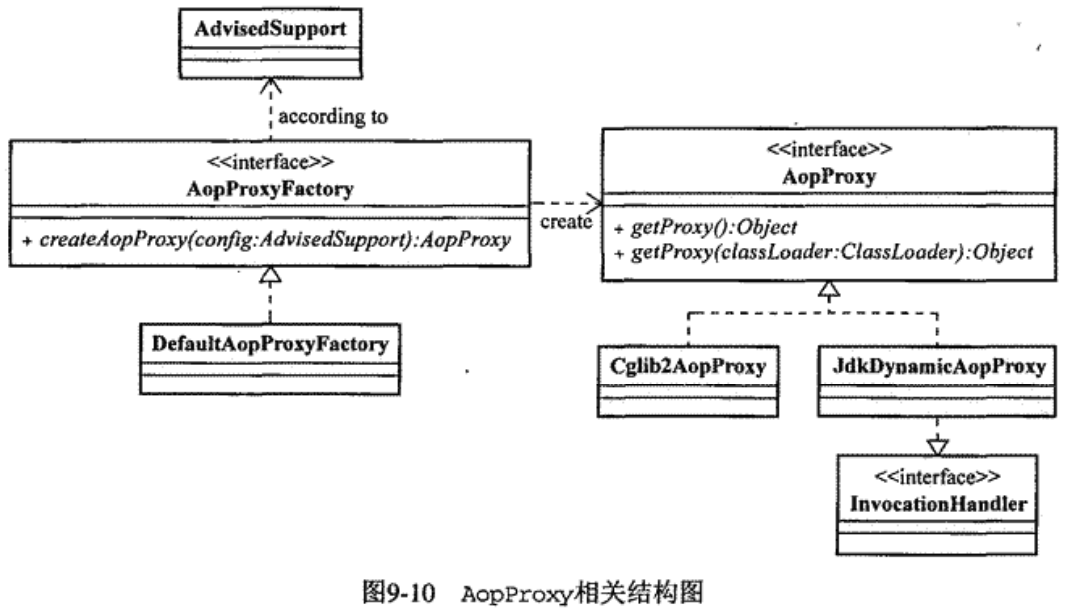
Spring AOP framework uses AopProxy to moderately abstract proxy implementation mechanisms used, mainly having two AopProxy implementations for JDK dynamic proxy and CGLIB mechanisms, namely Cglib2AopProxy and JdkDynamicAopProxy. Dynamic proxy needs to provide call interception via InvocationHandler, so JdkDynamicAopProxy also implements InvocationHandler interface. Adopting abstract factory pattern, proceeding through org.springframework.aop.framework.AopProxyFactory.
AopProxyFactory
public interface AopProxyFactory {
    AopProxy createAopProxy(AdvisedSupport config) throws AopConfigException;
}
AopProxyFactory decides what type of AopProxy to generate based on relevant information provided by passed AdvisedSupport instance. Specific work is completed by concrete implementation classes of AopProxyFactory. I.e., org.springframework.aop.framework.DefaultAopProxyFactory.
DefaultAopProxyFactory
package org.springframework.aop.framework;

import java.io.Serializable;
import java.lang.reflect.Proxy;

import org.springframework.aop.SpringProxy;

@SuppressWarnings("serial")
public class DefaultAopProxyFactory implements AopProxyFactory, Serializable {

    @Override
    public AopProxy createAopProxy(AdvisedSupport config) throws AopConfigException {
        // If isOptimize or isProxyTargetClass method of passed AdvisedSupport instance returns true,
        // Or target object does not implement any interface, then use CGLIB to generate proxy object, otherwise use dynamic proxy.
        if (config.isOptimize() || config.isProxyTargetClass() || hasNoUserSuppliedProxyInterfaces(config)) {
            Class<?> targetClass = config.getTargetClass();
            if (targetClass == null) {
                throw new AopConfigException("TargetSource cannot determine target class: " +
                        "Either an interface or a target is required for proxy creation.");
            }
            if (targetClass.isInterface() || Proxy.isProxyClass(targetClass)) {
                return new JdkDynamicAopProxy(config);
            }
            return new ObjenesisCglibAopProxy(config);
        }
        else {
            return new JdkDynamicAopProxy(config);
        }
    }

    private boolean hasNoUserSuppliedProxyInterfaces(AdvisedSupport config) {
        Class<?>[] ifcs = config.getProxiedInterfaces();
        return (ifcs.length == 0 || (ifcs.length == 1 && SpringProxy.class.isAssignableFrom(ifcs[0])));
    }

}
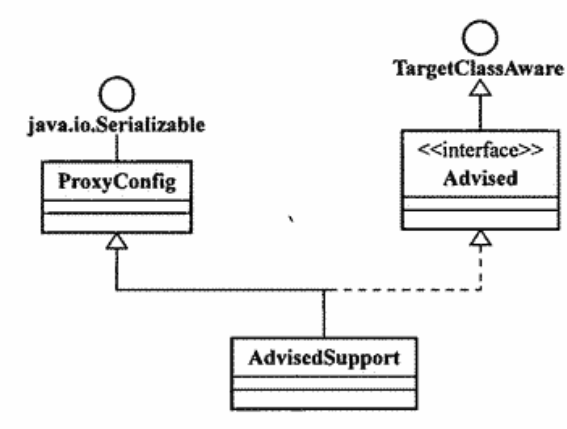
AdvisedSupport is a carrier of information needed to generate proxy object.
- One class headed by
org.springframework.aop.framework.ProxyConfig, records control information for generating proxy object; - One class headed by
org.springframework.aop.framework.Advised, carries necessary information needed to generate proxy object, such as related target class, Advice, Advisor etc.
ProxyConfig is a simple JavaBean, defining five boolean attributes, controlling what measures should be taken when generating proxy object respectively.
ProxyTargetClass: If this attribute is set to true,ProxyFactorywill use CGLIB to proxy target object. Default value is false.optimize: This attribute is mainly used to inform whether proxy object needs to take further optimization measures. If proxy object is generated, even if correspondingAdviceis added or removed for it, proxy object can ignore this change. If this attribute is set to true,ProxyFactorywill use CGLIB to proxy target object. Default value is false.opaque: This attribute is used to control whether generated proxy object can be forced directly to cast toAdvised, default value is false, meaning any generated proxy object can be forced cast toAdvised, we can query some states of proxy object viaAdvised.exposeProxy: SettingexposeProxyallows Spring AOP framework to bind current proxy object toThreadLocalwhen generating proxy object. If target object needs to access current proxy object, it can get proxy object viaAopContext.currentProxy(). For performance considerations, this attribute defaults to false.frozen: Iffrozenis set to true, once various information configurations for proxy object are completed, changes are not allowed. For example,ProxyFactoryis set up, andfrozenis true, then no changes can be made toAdvice, this can optimize performance of proxy object, defaults to false.
To generate proxy object, information provided by ProxyConfig alone is not enough, we also need some specific information for generating proxy object, for example, for which target classes to generate proxy object, what kind of cross-cutting logic to add to proxy object etc., this information can be set via org.springframework.aop.framework.Advised. By default, proxy objects returned by Spring AOP framework can all be forced cast to Advised, to query related information of proxy object.
We can use Advised interface to access all Advisor held by corresponding proxy object, perform actions like adding Advisor, removing Advisor etc. Even if proxy object has been generated, it can also be operated, operate Advised directly, more often used in testing scenarios, can help us check whether generated proxy object is as expected.
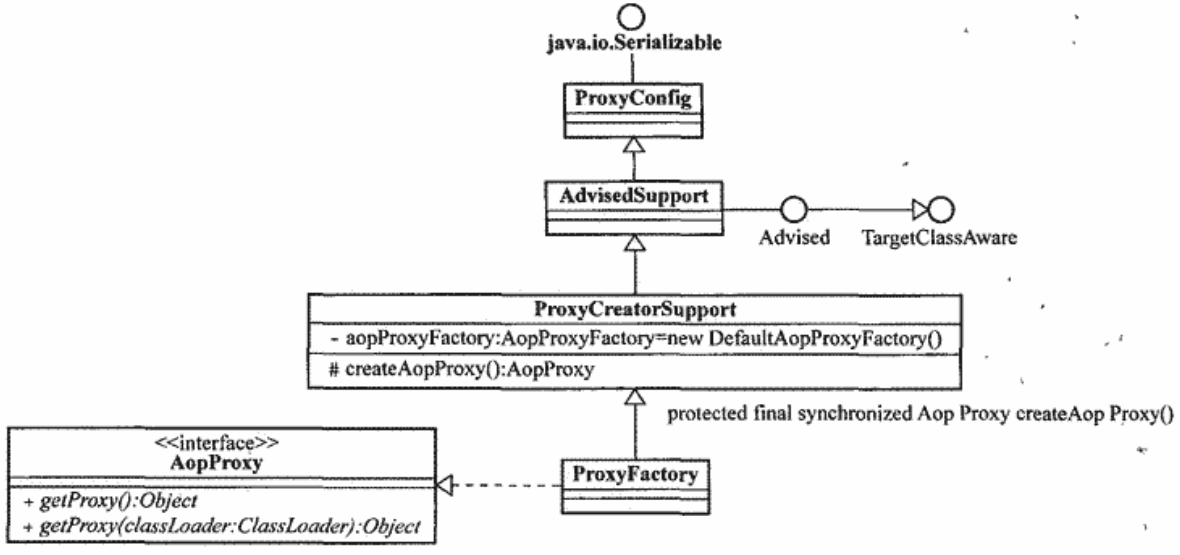
ProxyFactory combines AopProxy and AdvisedSupport in one, can set relevant information needed to generate proxy object via AdvisedSupport, can generate proxy object via AopProxy. To reuse relevant logic, Spring AOP framework extracted some common logic to org.springframework.aop.framework.ProxyCreatorSupport during implementation, it inherits AdvisedSupport, so it can have ability to set relevant information needed to generate proxy object.
In order to simplify work of generating different types of AopProxy, ProxyCreatorSupport internally holds an AopProxyFactory instance, default uses DefaultAopProxyFactory.
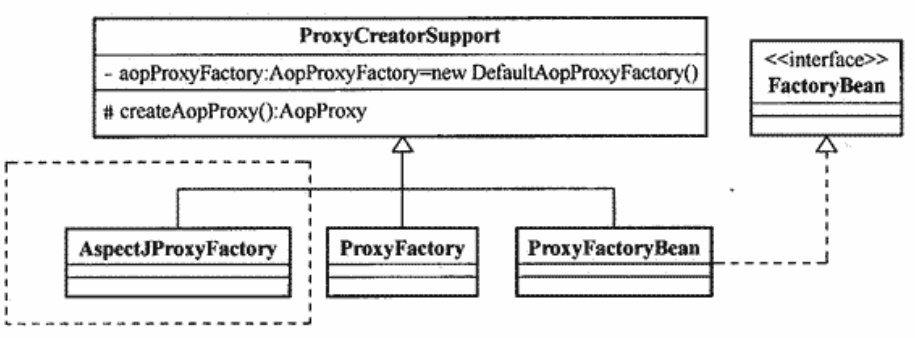
Essence of ProxyFactoryBean
ProxyFactoryBean is essentially a FactoryBean used to produce Proxy. Role of FactoryBean:
If an object holds a reference to a FactoryBean, what it gets is not FactoryBean itself, but object returned by FactoryBean's getObject() method. So, if an object in container depends on ProxyFactoryBean, then it will use proxy object returned by ProxyFactoryBean's getObject() method.
To let ProxyFactoryBean's getObject() method return proxy object of corresponding target object is actually very simple. Because ProxyFactoryBean inherits common parent class ProxyCreatorSupport of ProxyFactory, and ProxyCreatorSupport basically has completed all things to be done (setting target object, configuring other parts, generating corresponding AopProxy etc.). We only need to get proxy object via parent class's createAopProxy() in ProxyFactoryBean's getObject() method, then return AopProxy.getObject().
getObject()
public Object getObject() throws BeansException {
        initializeAdvisorChain();
        if (isSingleton()) {
            return getSingletonInstance();
        }
        else {
            if (this.targetName == null) {
                logger.info("Using non-singleton proxies with singleton targets is often undesirable. " +
                        "Enable prototype proxies by setting the 'targetName' property.");
            }
            return newPrototypeInstance();
        }
    }
ProxyBean definition requires indicating whether returned object is returned with singleton scope or prototype scope. Different proxy objects are returned for these two cases to satisfy semantics of FactoryBean's isSingleton() method.
If singleton attribute of ProxyFactoryBean is set to true, then after ProxyFactoryBean generates proxy object for first time, it will cache generated proxy object via internal instance variable singletonInstance (Object type). All subsequent requests return this cached instance, thus satisfying singleton semantics. Conversely, if singleton attribute of ProxyFactoryBean is set to false, then ProxyFactoryBean will re-check all settings every time, and prepare a new set of environment for current call, then return a new proxy object according to latest environment data. Therefore, if singleton attribute is false, there is loss in performance of generating proxy object.
Usage of ProxyFactoryBean
Like ProxyFactory, via ProxyFactoryBean, we can specify whether to use interface-based proxy or class-based proxy way when generating proxy object for target object, and, because they all inherit from same parent class, most setting items are same. ProxyFactoryBean adds its own unique ones besides inheriting all configuration attributes of ProxyCreatorSupport:
proxyInterfaces: If we want to use interface-based proxy way, then we need to configure corresponding interface types via this attribute, pass interface information of configuration element via Collection object. ProxyFactoryBean has an autodetectInterfaces attribute, this attribute defaults to true, if interface type to be proxied is not explicitly specified, ProxyFactoryBean will automatically detect interface types implemented by target object and perform proxy.
interceptorNames: Via this attribute, we can specify multiple Advice, interceptors and Advisor to be woven into target object, instead of adding Advice or addAdvisor method of ProxyFactory, usually we will use configuration element <list> to add needed interceptor names.
- If target object is not set, then can place Bean definition name of object at position of last element of
interceptorNames. It is recommended to define target object directly. - By adding * wildcard after specified
interceptorNameselement name, can letProxyFactoryBeansearch allAdvisormatching condition in container and apply to target object.
Example using wildcard
<beans>
    <bean id="proxy" class="org.springframework.aop.framework.ProxyFactoryBean">
        <property name="target" ref="..."/>
        <property name="interceptorNames">
            <list>
                <value>global*</value>
            </list>
        </property>
    </bean>

    <bean id="global_debug" class="org.springframework.aop.interceptor.DebugInterceptor"/>
    <bean id="global_performance" class="org.springframework.aop.interceptor.PerformanceMonitorInterceptor">
</beans>
singleton: ProxyFactoryBean is essentially a FactoryBean, so we can specify whether getObject call returns same proxy object or new one via singleton attribute.
ProxyFactoryBean Generating Proxy Object Case
Configuration File
<beans xmlns="http://www.springframework.org/schema/beans"
       xmlns:xsi="http://www.w3.org/2001/XMLSchema-instance"
       xmlns:context="http://www.springframework.org/schema/context"
       xsi:schemaLocation="http://www.springframework.org/schema/beans
        http://www.springframework.org/schema/beans/spring-beans-2.5.xsd
        http://www.springframework.org/schema/context
        http://www.springframework.org/schema/context/spring-context-2.5.xsd">

    <!--    Bean definition of target object-->
    <bean id="task"
          class="org.springframework.mylearntest.aop.weaver.baseoninterface.MockTask" scope="prototype"/>

    <!--    ProxyFactoryBean definition-->
    <bean id="introducedTask" class="org.springframework.aop.framework.ProxyFactoryBean" scope="prototype">
        <property name="targetName">
            <value>task</value>
        </property>
        <property name="proxyInterfaces">
            <list>
                <value>org.springframework.mylearntest.aop.weaver.baseoninterface.ITask</value>
                <value>org.springframework.mylearntest.aop.weaver.proxyfactorybean.ICounter</value>
            </list>
        </property>
        <property name="interceptorNames">
            <list>
                <value>introductionInterceptor</value>
            </list>
        </property>
    </bean>

    <!--    introductionInterceptor definition-->
    <bean id="introductionInterceptor"
          class="org.springframework.aop.support.DelegatingIntroductionInterceptor" scope="prototype">
        <constructor-arg>
            <bean class="org.springframework.mylearntest.aop.weaver.proxyfactorybean.CounterImpl"/>
        </constructor-arg>
    </bean>

</beans>
ICounter
package org.springframework.mylearntest.aop.weaver.proxyfactorybean;

/**
 * @Author: whalefall
 * @Date: 2020/7/22 23:34
 */
public interface ICounter {
    void resetCounter();
    int getCounter();
}
CounterImpl
package org.springframework.mylearntest.aop.weaver.proxyfactorybean;

/**
 * @Author: whalefall
 * @Date: 2020/7/22 23:35
 */
public class CounterImpl implements ICounter{
    private int counter;

    @Override
    public void resetCounter() {
        counter = 0;
    }

    @Override
    public int getCounter() {
        counter ++;
        return counter;
    }
}
TestProxyFactoryBean
package org.springframework.mylearntest.aop.weaver.proxyfactorybean;

import org.springframework.aop.support.DelegatingIntroductionInterceptor;
import org.springframework.context.ApplicationContext;
import org.springframework.context.support.ClassPathXmlApplicationContext;

/**
 * @Author: whalefall
 * @Date: 2020/7/22 23:51
 * @see DelegatingIntroductionInterceptor
 */
public class Test4ProxyFactoryBean {
    public static void main(String[] args) {
        ApplicationContext context = new ClassPathXmlApplicationContext("proxyfactorybean\\proxyfactorybean.xml");
        Object proxy1 = context.getBean("introducedTask");
        Object proxy2 = context.getBean("introducedTask");

        System.out.println(((ICounter)proxy1).getCounter());//1
        System.out.println(((ICounter)proxy1).getCounter());//2
        System.out.println(((ICounter)proxy2).getCounter());//1
    }
}
References
- Book Name: Spring Unveiled Author: Wang Fuqiang
- Attribution: Retain the original author's signature and code source information in the original and derivative code.
- Preserve License: Retain the Apache 2.0 license file in the original and derivative code.
- Attribution: Give appropriate credit, provide a link to the license, and indicate if changes were made.
- NonCommercial: You may not use the material for commercial purposes. For commercial use, please contact the author.
- ShareAlike: If you remix, transform, or build upon the material, you must distribute your contributions under the same license as the original.