Advice in Spring AOP
Please refer to spring-framework under org.springframework.mylearntest package for code related to this article (from official source spring-test module).
-
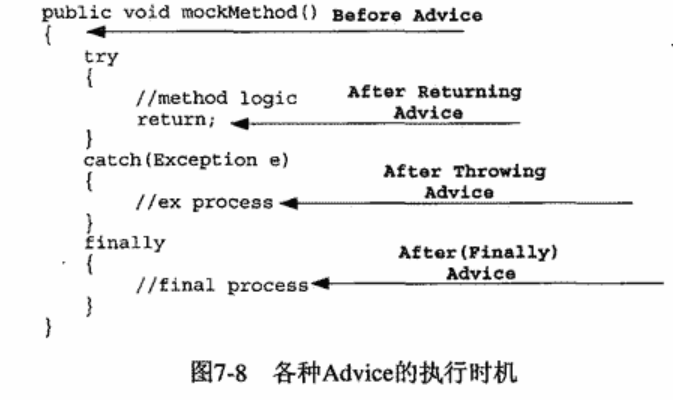
Before Advice
-
After Advice
After returning
After throwing
After Advice(finally)
- After Around
Introduction
It is called Inter-Type Declaration in AspectJ, and Mix-in in JBoss AOP, both refer to the same type of Advice. Unlike other types of Advice mentioned before, Introduction is not distinguished by the execution timing at Joinpoint based on cross-cutting logic, but is distinguished from other Advice types based on the functions it can complete.
AspectJ uses static weaving, so when the object is used, the Introduction logic has already been woven during compilation. Theoretically, Introduction type Advice provided by AspectJ has the best performance among AOP implementations on the existing Java platform; while AOP implementations using dynamic weaving like JBoss AOP or Spring AOP have slightly inferior performance for Introduction.
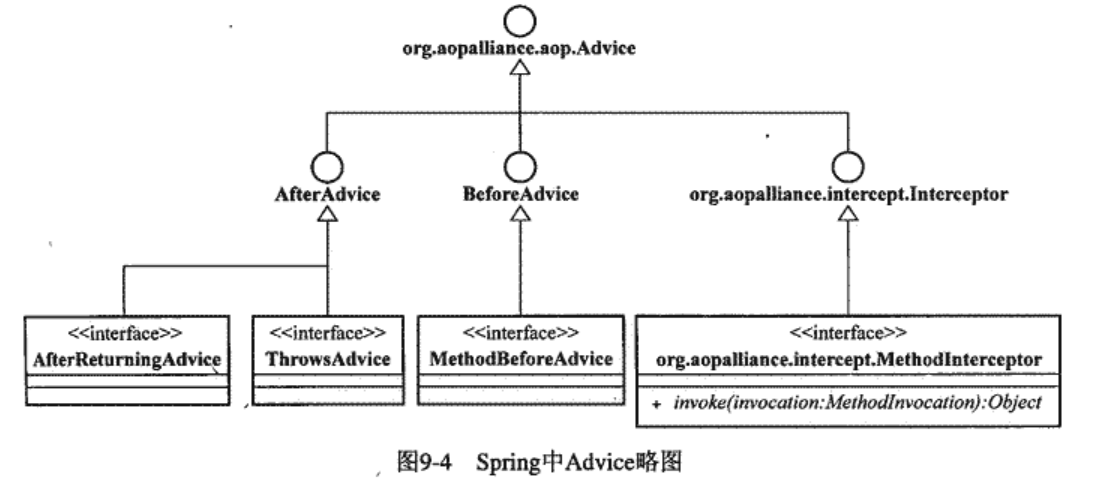
In Spring, Advice can be divided into two main categories based on whether its own instance can be shared among all instances of the target object class: per-class type Advice and per-instance type Advice.
per-class
per-class Advice means that the instance of this type of Advice can be shared among all instances of the target object class. Usually, this type of Advice only provides method interception functions and does not save any state or add new features to the target object class.
BeforeAdvice
ResourceSetupBeforeAdvice
package org.springframework.mylearntest.aop.advice;

import org.apache.commons.io.FileUtils;
import org.springframework.aop.MethodBeforeAdvice;
import org.springframework.core.io.Resource;

import java.lang.reflect.Method;

public class ResourceSetupBeforeAdvice implements MethodBeforeAdvice {
    private Resource resource;

    public ResourceSetupBeforeAdvice(Resource resource) {
        this.resource = resource;
    }

    @Override
    public void before(Method method, Object[] args, Object target) throws Throwable {
        if (!resource.exists()) {
            FileUtils.forceMkdir(resource.getFile());
        }
    }
}
ThrowsAdvice
ExceptionBarrierThrowsAdvice
package org.springframework.mylearntest.aop.advice;

import org.omg.CORBA.portable.ApplicationException;
import org.springframework.aop.ThrowsAdvice;

import java.lang.reflect.Method;

public class ExceptionBarrierThrowsAdvice implements ThrowsAdvice {
    public void afterThrowing(Throwable t) {
        // Normal exception handling
    }

    public void afterThrowing(RuntimeException t) {
        // Runtime exception handling
    }

    public void afterThrowing(Method m, Object[] args, Object target, ApplicationException e) {
        // Handle application-generated exceptions
    }
}
AfterReturningAdvice
This Advice can access the return value, method, method arguments, and the target object of the current Joinpoint, but cannot change the return value. You can use Around Advice to change the return value.
Around Advice
Spring does not define Around Advice, but directly uses the standard interface of AOP Alliance, implementing MethodInterceptor is enough.
per-instance
per-instance type Advice will not be shared among all object instances of the target class, but will save their respective states and related logic for different instance objects. In Spring, Introduction is the only per-instance type Advice.
Introduction can add new attributes and behaviors to the target class without changing the target class definition.
In Spring, to add new attributes and behaviors to the target object, corresponding interfaces and implementations must be declared. Then, through a specific interceptor, the new interface definition and the logic in the implementation class are attached to the target object. After that, the target object has new states and behaviors. This specific interceptor is org.springframework.aop.IntroductionInterceptor.
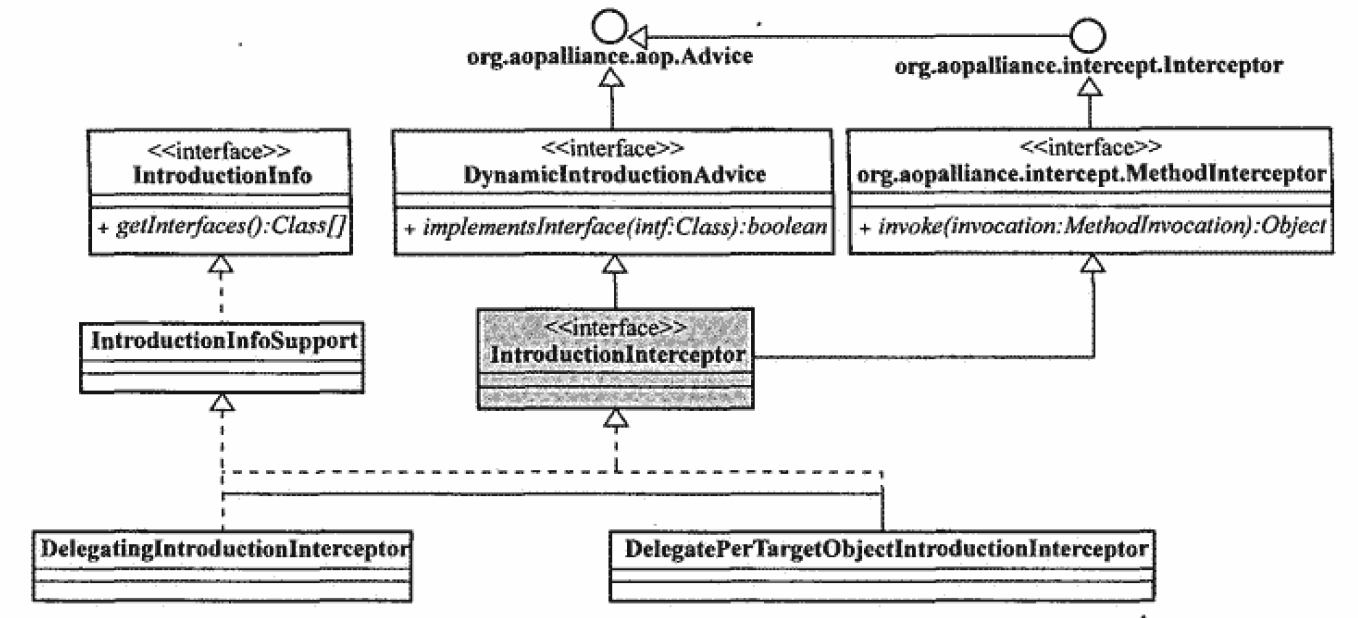
Introduction inherits MethodInterceptor and DynamicIntroductionAdvice. Through DynamicIntroductionAdvice, we can define for which interface classes the current IntroductionInterceptor provides corresponding interception functions. Through MethodInterceptor, IntroductionInterceptor can handle method calls on the newly added interfaces. Usually, for IntroductionInterceptor, if it is a method call on a newly added interface, there is no need to call the proceed() method of MethodInterceptor. The currently intercepted method is actually the only method to be executed in the entire call chain.
-
Introduction type Advice has two branches: dynamic branch headed by
DynamicIntroductionAdvice(non-shared) and static branch headed byIntroductionInfo(shared). -
DynamicIntroductionAdvicedoes not need to pre-set the target interface type; whileIntroductionInfois completely opposite, the implementation class must return the pre-determined target interface type.
IntroductionInfo
public interface IntroductionInfo {
    Class[] getInterfaces();
}
If you need to intercept the target object and add Introduction logic, you can use two existing implementation classes: DelegatingIntroductionInterceptor, DelegatePerTargetObjectIntroductionInterceptor.
DelegatingIntroductionInterceptor
DelegatingIntroductionInterceptor will not implement the new logic behavior to be added to the target object itself, but delegate it to other implementation classes.
Use DelegatingIntroductionInterceptor to enhance Developer. Interface omitted.
Developer
package org.springframework.mylearntest.aop.advice.perinstance.delegatingIntroductionInterceptor;

public class Developer implements IDeveloper{
    @Override
    public void developSoftware() {
        System.out.println(" do some developing ...");
    }
}
Define interface for new state and behavior. To add enhanced functions to the implementation class, first we need to declare the required functions in the form of interface definition.
ITester
package org.springframework.mylearntest.aop.advice.perinstance.delegatingIntroductionInterceptor;

public interface ITester {
    boolean isBusyAsTester();
    void testSoftware();
}
Provide implementation class for the new interface. The interface implementation class gives the concrete logic to be added to the target object. When the target object wants to exercise the new function, it will seek help through this implementation class.
Tester
package org.springframework.mylearntest.aop.advice.perinstance.delegatingIntroductionInterceptor;

public class Tester implements ITester{
    private  boolean busyAsTester;

    public void setBusyAsTester(boolean busyAsTester) {
        this.busyAsTester = busyAsTester;
    }

    @Override
    public boolean isBusyAsTester() {
        return busyAsTester;
    }

    @Override
    public void testSoftware() {
        System.out.println("do some developing and test ...");
    }
}
Perform Introduction interception via DelegatingIntroductionInterceptor. With the interface of newly added functions and corresponding implementation class, using DelegatingIntroductionInterceptor, we can delegate specific Introduction interception to concrete implementation class to complete.
How to weave
ITester delegator = new Tester();
DelegatingIntroductionInterceptor interceptor = new DelegatingIntroductionInterceptor(delegator);

// Weaver
ITester tester = (ITester)weaver.weave(developer).with(interceptor).getProxy();
tester.testSoftware();
Although DelegatingIntroductionInterceptor is an implementation of Introduction type Advice, its implementation fundamentally does not fulfill the promise of Introduction being per-instance type. actually DelegatingIntroductionInterceptor will use the same "delegate" interface instance it holds, shared by all instances of the same target class. If we strictly want to achieve the effect of Introduction type Advice, we should use DelegatePerTargetObjectIntroductionInterceptor.
DelegatePerTargetObjectIntroductionInterceptor
Unlike DelegatingIntroductionInterceptor, DelegatePerTargetObjectIntroductionInterceptor will internally hold a mapping relationship between target object and corresponding Introduction logic implementation class. When new defined interface method on each object is called, DelegatePerTargetObjectIntroductionInterceptor will intercept these calls, then use target object instance as key to get Introduction implementation instance corresponding to current target object instance from the mapping relationship it holds.
DelegatePerTargetObjectIntroductionInterceptor interceptor1 =
                new DelegatePerTargetObjectIntroductionInterceptor(Tester.class,ITester.class);
Extending DelegatingIntroductionInterceptor
TesterFeatureIntroductionInterceptor
package org.springframework.mylearntest.aop.advice.perinstance;

import org.aopalliance.intercept.MethodInvocation;
import org.apache.commons.lang3.StringUtils;
import org.springframework.aop.support.DelegatingIntroductionInterceptor;

public class TesterFeatureIntroductionInterceptor extends DelegatingIntroductionInterceptor implements ITester {

    public static final long serialVersionUID = -3387097489523045796L;
    private boolean busyAsTester;

    @Override
    public Object invoke(MethodInvocation mi) throws Throwable {
        if (isBusyAsTester() && StringUtils.contains(mi.getMethod().getName(), "developSoftware")) {
            throw new RuntimeException("I'am so tired");
        }
        return super.invoke(mi);
    }

    @Override
    public boolean isBusyAsTester() {
        return busyAsTester;
    }

    public void setBusyAsTester(boolean busyAsTester) {
        this.busyAsTester = busyAsTester;
    }

    @Override
    public void testSoftware() {
        System.out.println("I will ensure the quality");
    }
}
- Attribution: Retain the original author's signature and code source information in the original and derivative code.
- Preserve License: Retain the Apache 2.0 license file in the original and derivative code.
- Attribution: Give appropriate credit, provide a link to the license, and indicate if changes were made.
- NonCommercial: You may not use the material for commercial purposes. For commercial use, please contact the author.
- ShareAlike: If you remix, transform, or build upon the material, you must distribute your contributions under the same license as the original.